

Roof Damage Claims
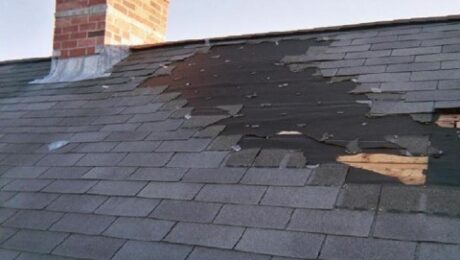
- Published in Blog
FAQs for Business Owners
Q: With my store being closed for over a month, I am losing money. How can a Public Adjuster help me?
Q: Since the flood we have not been able to use the east side of the hotel, without the normal income of a full hotel we are unable to make ends meet. Can a Public Adjuster help me some money sooner?
Q: Since my tenants have had to move out of my rental property, there is no income coming in and i am unable to stay afloat for much longer. Can a public adjuster help me?
A: As a business owner, cash flow problems are among one of the most severe consequences when dealing with a settlement of a large property- loss claim. This is another way that the expertise All American Public Adjusters, Inc has can help you. Quite often wear able to negotiate with the insurance company to advance money to deal with the most important needs.
Q: My employees and I have attempted to remember everything that was in the storage rooms through the facility. How can a Public Adjuster help me with this?
Q: The fire destroyed all of my records necessary to prove my claim. Can a Public Adjusters help me reconstruct the inventory?
Q: I’ve asked my employees to help, but we are all having trouble remembering what all we had stored in our storage rooms throughout our facility. How could a Public Adjuster possibly be able to help me with this problem?
A: All American Public Adjusters can help you with this problem by reconstructing and inventory of your damaged or lost contents. We are knowledgeable in the right questions to ask and how to re-document the prices of items for which you no longer have receipts for. We are able to anticipate the problem and therefore making the process quicker and easier.
Q. In our factory we have unique equipment. How can I convince my insurance company’s adjusters of how much it will cost to replace the expensive machinery?
A: As with any policy the contract is between you and your insurance company and requires you to prove your loss. All American Public Adjusters, Inc experts will document your loss as proof for your claim and will negotiate in order to get them to agree with our estimates.
- Published in F A Q
FAQs FOR HOMEOWNERS
Q: We currently cannot stay at our house and are living in temporary quarters; due to this we must drive our children to school every day. This leads to us incurring bills we normally would not have. What can a Public Adjuster do to help cover this additional expense by the insurance company?
Q: Since the loss occurred we have been staying in a motel, now we realize that the house will not be ready for several months. As a Public Adjuster help us get relocated to a house?
A: As a homeowner you may not be aware of the very helpful “Additional Living Expenses†(ALE) provision of their insurance policy. This provides a way for someone who has suffered a loss to be able to continue living life as comfortable as possible until the home is inhabitable again. At all American Public Adjusters we are experienced in helping our clients receive the full benefits from this coverage. In the past we have been successful in negotiating with your insurance company to get them to advance money for you to be able to survive while your claim is being settled. Call All American Public Adjusters, Inc now to find out how we can help you stay afloat during this rough time.
Q: My husband and I cannot remember everything we had stored in our basement. How can a Public Adjuster help me?
Q: All my records necessary to prove my claim were destroyed in the fire. Can a Public Adjuster help me reconstruct inventory of the contents lost?
A: All American Public Adjusters, Inc is extremely experienced in these types of very real scenarios. With our help we will be able to reconstruct an inventory of your contents. We are aware of the sorts of questions to ask, and are able to re-document the prices of items for which you no longer have receipts. We are also familiar with what the insurance company’s adjusters objections. Therefore we are able to make sure your claim is completed properly.
- Published in F A Q
F A Q

Q: What is a Public Adjuster?
A: Public Adjusters are extensively trained on property loss estimating and assisting in documenting, negotiating and settling insurance claims. Our Public Adjusters will take care of your claim from beginning to end. They will work closely with you in insure that the insurance company provides you with the most reasonable and prompt settlement
Public Adjusters are not attorneys and can only represent you with regard to your first party insurance claim. They cannot represent you in court nor can they represent you if you have a claim against a third party.
Q: Why do I need a Public Adjuster?
A: As experts in policy and insurance a Public Adjust works to get the compensation you deserve in order to fix your loss. While the insurance company is not always on your side and does not hold out for your best interest, All American Public Adjuster is always on your side.
Q: What is the cost to retain a Public Adjuster?
A: Public Adjusters will establish a percentage charge of the net settlement of the claim. This will be established at the start of your claim process. Once the claim is settled, the customer will receive payment of the entitled compensation and will be responsible for remittance to the Public Adjuster. If All America Public Adjuster, Inc. does not succeed in collecting a settlement, YOU ARE NOT responsible for any payment.
Q: I don’t understand what a Public Adjuster can do for me that I can’t do myself.
A: The insurance policy is a contract agreed upon at time of purchase. You as the policyholder and your insurance company as the insurer are held to very specific obligations. The most crucial fact of the policy, is that in order to get your insurance company to pay for your losses, you have to prove your claim to them. While many try to do this process themselves, they quickly come to realize that it is impossible for them to get the results that a trained professional will be able to achieve. In order to achieve the desire results you will have to become an overnight expert in pricing of everything from loss of use income to depreciation and of course become a will have to become a wiz at organizational and negotiating skills that are developed only from years of training. Often you forget how little time you actually have, when filling your claim without a Public Adjuster often this will become your full-time job for months and even years. When hiring All American Public Adjusters, Inc we will make sure that the process is smooth and proceeds as quickly as possible so your life is not affected further.
Q: The insurance company’s adjuster seems very knowledgeable about the claims process. Why should I be concerned about him misleading me?
A: In most cases the insurance company’s adjuster is knowledgeable, after all this is his job. But just like in divorce you wouldn’t use your ex’s attorney, why would you use your insurance companies adjuster? The expectation is that you are already aware and know how to do what is required to convince them and there employer that they ought to pay you for what you are claiming you have lost. You must bear in mind that insurance companies are for profit business and they must worry about the bottom line at all times, because of this there goal is not to fix your loss but to not pay out more then the bare minimum on the claims they receive.
Do not hesitate call All American Public Adjusters, Inc, our trained and experienced professionals are here to represent and guide you through the intricacies of documenting, presenting, and negotiating with your insurance companies. They will help you receive what you deserve for your loss, based in the maximum mount your coverage entitles you to.
Q. I still don’t see why I need a Public Adjuster – I already have an Independent Adjuster working on my claim.
A: Just as the claim process is confusing, understanding the types of adjusters maybe difficult. The word “independent” means that the licensed adjuster is able to represent more then one insurance company. Although his is “independent” he does represent the company and not the policyholder. His income or commissions are paid by the company that is represented and that is where his loyalty will always be. A Public Adjuster on the other hand has been licensed to represent individuals who have purchased a policy from an insurance company. As a consumer you are part of the public and therefore the only type of adjuster who can represent your needs is one who has the word “PUBLIC” in their title.
Q. How is a Public Adjuster paid, and how much?
A: A Public Adjusters fee in all cases is a percentage of the total amount you receive for a claim. All American Public Adjusters is not paid anything until you have been paid. Please note that in many cases we are able to help you use your policy’s benefits in such a way that it will help to more then make up for the fee.
Q. Do Public Adjusters have to be licensed or certified?
A: The majority of states do require Public Adjusters to be licensed and bonded by each state’s Department of Insurance. All American Public Adjusters, Inc is licensed in Florida, Georgia, North Carolina, Tennesee, Illinios, New Jersey, New York, Nebraska, Kansas, Colorado. If your state is not listed don’t worry we can still help.
Q: My policy says I’m supposed to make some temporary repairs to protect my damaged property. How do I know what to repair now and what to wait till later to repair?
A: All American Public Adjusters, Inc will help you make these important decisions, as this is included in the many service we currently provide for our clients. Our general advice, after a loss it that you should protect your property as if you do not have insurance. Our knowledge in this area will definitely help to ensure you collect for all damages. Call All American Public Adjuster right away so we can help you from the beginning of the process.
Q: We have a lot of building contractors and cleaning/restoration companies knocking on our door, wanting to do our work and help us file out insurance claim. Why should I hire a Public Adjuster to do this for us, instead?
A: Many policyholders have developed confusion from this fairly recent development. Salesman and building contractors have begun presenting themselves a being qualified to help you with the intricacies of your insurance policy as well as claiming to have expertise in helping you to get the insurance company to pay for your repairs and cleanup. In reality, in most cases, these people are not licensed in any state to act as a claim adjusters, nor do they possess the necessary training. Often they are treading on the fine line with separates adjusters from builders, that is imposed by ethics. Contacting All American Public Adjusters ensures that you have a licensed and trained representative in documenting and settling your claim. We can also help you find ethical, bonded contractors to complete your repairs.
Q: Isn’t it a good idea to go ahead and get everything cleaned now by a professional restoration service instead of waiting until I have settled my claim?
A: Absolutely not! As a policyholder this is probably the single biggest mistake you can make.The reason for this is once the process had begun, the cleaning bill reduces the amount of coverage you have left to replace what has been destroyer or damaged in your loss. Although it s a well intentioned mistake it clearly illustrates why policyholders like yourself are in need of a Public Adjusters on there side. To avoid costly mistakes like this, call All American public Adjusters, Inc and speak to one of our trained professionals.
Q: Who decides if an item needs to be repaired or replaced? My insurance company and I are disagreeing on just about everything.
A: The policy, which is a contract between you and the insurance company has terms that require you to prove your loss. As your representative, All American Public Adjusters, Inc will work to justify your claim by documenting, and negotiate with the insurance company’s representative on your behalf in order to get them to agree with our decisions on these issues. If no agreement can be agreed upon by you and the insurance company, the Appraisal Claus of your policy may be on option considered. Please see the Appraisal Clause Section of this website, for more information on this option.
FAQs FOR HOMEOWNERS
Q: We currently cannot stay at our house and are living in temporary quarters; due to this we must drive our children to school every day. This leads to us incurring bills we normally would not have. What can a Public Adjuster do to help cover this additional expense by the insurance company?
Q: Since the loss occurred we have been staying in a motel, now we realize that the house will not be ready for several months. As a Public Adjuster help us get relocated to a house?
A: As a homeowner you may not be aware of the very helpful “Additional Living Expenses” (ALE) provision of their insurance policy. This provides a way for someone who has suffered a loss to be able to continue living life as comfortable as possible until the home is inhabitable again. At all American Public Adjusters we are experienced in helping our clients receive the full benefits from this coverage. In the past we have been successful in negotiating with your insurance company to get them to advance money for you to be able to survive while your claim is being settled. Call All American Public Adjusters, Inc now to find out how we can help you stay afloat during this rough time.
Q: My husband and I cannot remember everything we had stored in our basement. How can a Public Adjuster help me?
Q: All my records necessary to prove my claim were destroyed in the fire. Can a Public Adjuster help me reconstruct inventory of the contents lost?
A: All American Public Adjusters, Inc is extremely experienced in these types of very real scenarios. With our help we will be able to reconstruct an inventory of your contents. We are aware of the sorts of questions to ask, and are able to re-document the prices of items for which you no longer have receipts. We are also familiar with what the insurance company’s adjusters objections. Therefore we are able to make sure your claim is completed properly.
FAQs for Business Owners
Q: With my store being closed for over a month, I am losing money. How can a Public Adjuster help me?
Q: Since the flood we have not been able to use the east side of the hotel, without the normal income of a full hotel we are unable to make ends meet. Can a Public Adjuster help me some money sooner?
Q: Since my tenants have had to move out of my rental property, there is no income coming in and i am unable to stay afloat for much longer. Can a public adjuster help me?
A: As a business owner, cash flow problems are among one of the most severe consequences when dealing with a settlement of a large property- loss claim. This is another way that the expertise All American Public Adjusters, Inc has can help you. Quite often wear able to negotiate with the insurance company to advance money to deal with the most important needs.
Q: My employees and I have attempted to remember everything that was in the storage rooms through the facility. How can a Public Adjuster help me with this?
Q: The fire destroyed all of my records necessary to prove my claim. Can a Public Adjusters help me reconstruct the inventory?
Q: I’ve asked my employees to help, but we are all having trouble remembering what all we had stored in our storage rooms throughout our facility. How could a Public Adjuster possibly be able to help me with this problem?
A: All American Public Adjusters can help you with this problem by reconstructing and inventory of your damaged or lost contents. We are knowledgeable in the right questions to ask and how to re-document the prices of items for which you no longer have receipts for. We are able to anticipate the problem and therefore making the process quicker and easier.
Q. In our factory we have unique equipment. How can I convince my insurance company’s adjusters of how much it will cost to replace the expensive machinery?
A: As with any policy the contract is between you and your insurance company and requires you to prove your loss. All American Public Adjusters, Inc experts will document your loss as proof for your claim and will negotiate in order to get them to agree with our estimates.
- Published in F A Q
Are you covered by your homeowner’s insurance?

Are you covered by your homeowner’s insurance?: fox10tv.com
Angie’s List
Your home is a big investment and it’s an investment you want to protect. But when was the last time you reviewed your homeowner’s insurance coverage?
A nationwide Angie’s List poll found:
96% have homeowner’s insurance
Nearly 30 percent of respondents to a nationwide Angie’s List poll said it’s been two years or more since they reviewed their coverage with their agent.
Homeowner’s insurance is designed to protect damage from specific weather disasters, fire, theft, injuries, etc. You must then buy separate policies for floor and earthquake coverage.
Angie’s List, the nation’s leading provider of consumer reviews, asked highly rated insurance agents about homeowner’s insurance coverage.
10 tips to help homeowner’s get proper coverage:

Annual review: When you get your renewal notice, talk to your agent about whether you need to adjust your coverage. Update your policy if you have added square feet, remodeled, bought expensive items like jewelry/artwork/electronics, added a pet, boat, changes in your household, etc. Determine whether you have adequate liability insurance to protect yourself if someone is injured on your property. Consider increasing your liability protection if you install a pool, etc.
Get what you need: Replacement cost insurance covers the cost of replacing your home and is generally the policy for most homeowners. Your agent will evaluate your home and its contents and write a policy that would replace it at that value.
Get specific. Find out what your policy says about storm, water, mold, wind and flood coverage. In the past 10 years, companies have increasingly changed the language about these specific items. Ask about adding specific endorsements if your agent or company doesn’t offer the coverage you want.
Flood warning. If you live in a low-lying area or one that is predisposed to flooding, purchase flood insurance from the National Flood Insurance Program.
Get loss of use coverage. Consider loss of use insurance to cover rent or hotel fees in the event your home is uninhabitable after a catastrophe. Experts recommend at least one year of coverage.
Claim deadline. Check with your state’s Department of Insurance for the statute of limitations for filing a claim, which can vary from one to two years.
Safe keeping. Put important paperwork, especially policy information, in a fireproof/waterproof safe. Take photos and videos of everything in your home. Keep the originals in a safe-deposit box and send copies to relatives or friends across the country.
Ask around. Don’t take an insurance adjuster’s proof-of-loss statement as accurate. Instead, use at least three independent contractors’ estimates as your starting point. The insurance company’s initial payout is often drastically lower than what the work will require.
Public adjuster. If you experience a sizable loss, consider hiring a public insurance adjuster who will file and submit your claim on your behalf. These adjusters often have years of experience on the private insurance side and work to get homeowners the best settlement possible. Their compensation is a percentage of your settlement. That percentage varies by state.
Crash course. Familiarize yourself with what you are entitled to receive in the event of a loss. Ask your agent about his or her experience in handling a loss claim. An experienced agent should be able to not only detail what your policy will and will not cover, but be able to give you a good idea of what to expect if a claim takes place.
Angie’s List Tips to get the best deal:
Improve your home’s safety: Severe weather, higher rebuilding costs and an increase in claims can all affect the price of your premium. Some companies offer discounts for installing storm shutters, adding a security system, updating wiring, or your home’s proximity to a fire station.
Bundle up: Many companies will reduce your rates if you purchase additional policies, such as auto or life, through them.
Raise your deductible: Just remember if you do have a claim, you are going to have to pay more out of pocket then you would have before.
Shop around: Like any other service, shop around for homeowner’s insurance rates. You can comparison shop online with just a click of a mouse. Comparing policy coverage options with a few companies will give you the opportunity to find the best policy at the best price.
- Published in In the News
Hurricane Irene Aftermath
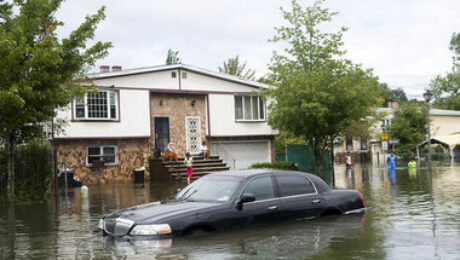
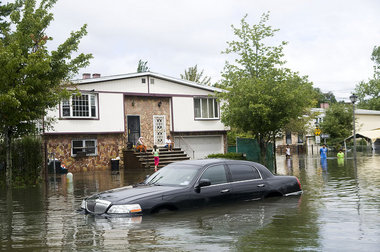
New Jersey homeowners and business owners should expect to feel the effect of Tropical Storm Irene for years to come, insurance industry representatives and analysts say.
Private insurers are in the midst of shelling out roughly $915 million to cover damage from the storm in the state alone, according to the latest estimates by ISO, a Jersey City-based insurance risk advisory group. These insured losses, along with roughly $150 million to cover October’s freak snowstorm and $21.8 million for a string of severe weather last March, will be factored into the rate reviews that insurance companies make over the coming years, industry analysts say.
All told, the three events sapped nearly $1.1 billion from private insurers, making 2011 the costliest for New Jersey underwriters in ISO’s records. By comparison, New Jersey’s insured losses in 2010, which saw a devastating March nor’easter, were $486.7 million, said ISO, a leading provider of data on property and casualty insurance risk.
Though no single event sets the price of insurance, the rising toll of covering catastrophes in the state, across the nation and around the world will be reflected in rising premiums to come, industry watchers say.
“When companies experience high catastrophe losses in a certain region, they have to raise prices to recover their margins,” said Jimmy Bhullar, an insurance analyst at JPMorgan Chase.
Robert Hartwig, president and economist of the Insurance Information Institute, estimates that catastrophes will push the most common homeowner premium this year past the thousand-dollar mark.
U.S. homeowners on average paid $880 for the most common policy in 2009, according to data released this month by the National Association of Insurance Commissioners. Hartwig notes that prices have continued to rise for subsequent years and projects that nationally, the most common policy in 2012 will cost on average $1,004. Historically, New Jersey’s homeowner premiums have trailed U.S. averages.
Spokespeople for the state’s top home insurers said it’s too early to tell how last year’s storms will impact rates in New Jersey, and the state Department of Banking and Insurance, which approves rate changes in the state, is not anticipating increased requests to raise premiums due to last year’s storms, a spokesman for the regulator said.
But insurance executives have that warned higher rates are coming. Two-thirds of the executives who responded to a recent Insurance Information Institute survey said they expect premium growth in 2012, which can mean a combination of attracting new policyholders and raising rates on existing ones.
Tom Wilson, chairman and CEO of Allstate, told attendees at a Goldman Sachs-sponsored conference in December that large catastrophe losses of recent years have weighed on company profit. One way it is responding is to raise prices “dramatically,” Wilson said: 9 percent in 2009, 8 percent in 2010 and 6 percent through the first nine months of 2011.
“Raising price obviously brings in more money, which covers those increased costs,” he said.
Dino Robusto, president of personal lines and claims at Chubb, the Warren-based insurer, said on a call with analysts in October that the company has received approval to increase homeowner rates by 3 percent to 4 percent in key states “and we anticipate filing for additional rate increases as needed.”
Shared Pain
The world has seen an explosion of natural disasters in recent years, but the catastrophes that struck last year made 2011 the costliest on record both globally and in New Jersey. The tsunami-sparked meltdown of the Fukushima nuclear plant in Japan, flooding in Thailand and earthquakes in New Zealand were among 820 events around the world that caused, collectively, about $380 billion in damage, of which $105 billion was borne by insurance companies, according to Munich RE, one of the world’s largest providers of insurance to insurance companies.
href=”https://www.getclaimhelp.com/?attachment_id=597″ rel=”attachment wp-att-597″>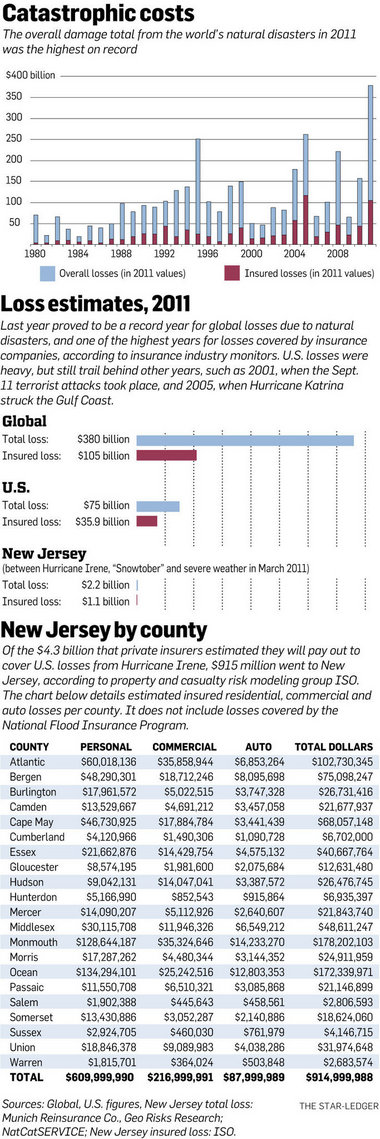
Overall damages in the United States last year paled in comparison to 2005, when Hurricanes Katrina and Rita punished the Gulf Coast and contributed to nearly $200 billion in total losses. But Irene, the deadly tornado in Joplin, Mo., and a record drought in Texas pushed the U.S. tally to about $75 billion of the world’s total losses, said Munich RE, whose U.S. headquarters are in Princeton. Of that, $35.9 billion was privately insured.
Irene alone is estimated to have cost the United States about $10 billion, of which $4.3 billion was covered by private insurers, Munich RE and the Insurance Information Institute have found.
The insured losses from Irene do not include claims covered by the federal National Flood Insurance Program. About $703.5 million has been approved for claims rising out of Irene, according to the Federal Emergency Management Agency, which administers the flood insurance program. Of that, $249.4 million went to New Jersey claims, FEMA said.
Private insurers that underwrite policies in New Jersey took the brunt of the storm, estimates from ISO show. They absorbed about 21 percent of the insured losses from Irene, which struck 13 states and Washington, D.C. The carriers are paying more than three times what the federal government has paid for flood insurance claims so far. Every county in the state reported seven-figure losses to private insurers, from $2.7 million in Warren County to $178.2 million in Monmouth County, said ISO.
Catastrophe Hit
The losses have eaten away at balance sheets. Last year, the property and casualty insurers paid $1.08 for every $1 they received in premiums, according to data from the Insurance Information Institute. That is the highest such ratio since 2001, and it is due to high catastrophe losses, dwindling reserves and the toll of the soft market, the institute said.
During the first nine months of 2011, private U.S. property and casualty insurers saw their net income dive to $8 billion from $27.1 billion during the same period in 2010, a 70 percent plunge, according to a joint study by ISO and the Property Casualty Insurers Association of America. Most of that was due to losses from major catastrophes, the groups wrote in a Dec. 27 release.
Chubb was among those hard-hit by Irene. Its third-quarter profit, reported in October, dropped 48 percent owing largely to catastrophe losses. Chubb in 2010 was New Jersey’s fourth-largest home insurer by market share, according to DOBI.
An Alternate Model
As punishing as 2011 was to insurers, individual catastrophes on their own do not drive up the cost of property insurance, companies and industry representatives say. Rather, companies use catastrophe risk models that assess disasters over many years and alongside other factors such as construction costs and commodity prices, which impact, for example, the cost of replacing asphalt, aluminum siding or copper pipes.
Some companies do not factor in actual claim experience from massive storms but use historic averages instead in order to smooth out spikes, said Deana Lykins, president of the Insurance Council of New Jersey. “This has the effect of dampening the impact of any individual event on the rate-setting process,” she said.
Yet insurance companies are reassessing their use of catastrophe-risk models, and the models themselves are changing after they failed to predict the toll of recent disasters, said Bhullar of JPMorgan.
Hartwig of the Insurance Information Institute said he expects the enormous impact of natural disasters last year, both in the United States and abroad, to drive rate increases in the years to come, even though the industry as a whole remains very well-capitalized.
He did not have a projection for New Jersey homeowner rates but said dwellers in coastal and high-value areas, as well as those hit hard by Irene, should expect to see their rates hiked. New Jersey homeowners have paid less than the national average, or $848 for the most common premium in 2009, according to the most recent NAIC data.
Rates in Check
Chris Hackett, director of personal lines policy for the Property Casualty Insurers Association, agreed that consumers in disaster-swept areas should expect to see a rise in rates. “It does come down to claims data in specific geographic areas,” he said.
But a number of global factors will keep rates in New Jersey from rising too high, insurance regulators say.
Most of New Jersey’s carriers were not directly exposed to catastrophic losses from around the world, said Marshall McKnight, a spokesman for the state’s banking and insurance regulator. Meanwhile the cost of reinsurance, the coverage that insurers buy to protect themselves and a factor in pricing premiums, has remained low, he said.
Mike Chaney, Mississippi’s insurance commissioner and chairman of NAIC’s property and casualty insurance committee, said the despite the “wishful thinking” of insurance company CEOs for higher premiums, other factors in the global economy will conspire to keep rates from rising too high. For example, low interest rates have made the reinsurance market an attractive place to park capital, which in turn will keep rates low, he said.
State regulators also have the ability to deny rate increases submitted for their approval if they are not adequately justified.
State Farm — New Jersey’s largest home insurer by market share, according to DOBI — last year in New Jersey handled 21,000 homeowners’ claims and another thousand automobile claims tied to catastrophe, said spokeswoman Arlene Lester. Yet the insurer, which has received rate increases averaging more than 6 percent nationwide over the last three years, is “not anticipating at this moment” a rate increase in light of claims being paid out, she said.
Allstate, the state’s second largest home insurer by market share, had a 5.9 percent increase in its homeowner rates in December, but the rate was filed before Irene and did not reflect losses from the storm, said spokesman Daniel Jovic.
A spokesman for New Jersey Manufacturers Insurance Co., the state’s third-largest home insurer by market share, said it is too early to tell what effect the disasters of the past year will have on rates. But the cost already has been tremendous. The mutually held company expects to pay out $76 million to cover home and auto claims from Irene, the costliest event in its near-century history, said spokesman Patrick Breslin. Its second- and third-most costly events were the March 2010 nor’easter, which cost $25 million, and October’s snowstorm, which tapped an estimated $13 million, he added.
But as large as Irene was, NJM did not have to call upon its reinsurance to help it cover claims, Breslin said. “We have prepared for catastrophes like this.”
- Published in In the News
Flood Damage
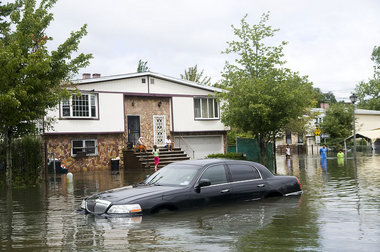
Living in a house next to the water can be serene and beautiful, but only if you have intentionally chosen that location! Flood damage can be one of the most devastating experiences that a homeowner can go through. Water is a powerful force and can cause a lot of damage and literally wash away all your belongings and investments. Just the smallest amount of flooding can result in large costs, for those with flood insurance, getting your claim paid can be a complex issue. When your belongings and investment, your home, is on the line its time to hire a professional who can take of the claim filing process and take over for you ensuring that your investments will not be lost.
Hire an Expert Flood Claim Specialist
When dealing with the aftermath of flood damage, you need an experienced and knowledgeable Public Adjuster. Not having a public adjuster represent you in the event of any damage to your home is similar to not having an attorney represent you in legal matters. Insurance Companies hire the best to protect their assets. SO SHOULD YOU!
Contact All American Public Adjusters Inc. today, and let us maximize the value of your insurance claim. Don’t fight the insurance companies alone. All American Public Adjusters Inc is one of the most reputable Adjusting firms in the Nation and has extensive experience dealing with Insurance Companies. Contact us today and allow us to help you get the money you deserve!
[representyouinsurancepolicies] [footer1]- Published in Blog
Frozen Pipes / Pipe Breaks
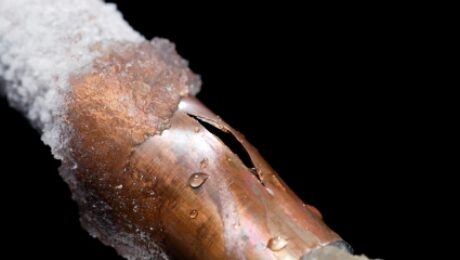
A pipe break due to frozen or improperly installed pipes can be a very frustrating issue to deal with. Does your policy cover pipe breaks? What is the deductible that you will have to pay? Which of your personal affects can be recovered and which are lost? These are just some of the questions you have to ask yourself before you begin the process of filing a claim, which in itself can be a tedious and time consuming process! The best decision you can make in dealing with a pipe break is to contact a Public Adjuster. All American Public Adjusters is licensed and very experienced in dealing with Insurance Companies to ensure you get the assistance you deserve. We will evaluate your property and provide the proper estimates at no cost to the homeowner. We have extensive experience which we utilize when negotiating with your insurance company to achieve a maximum settlement. All American Public Adjusters, Inc will assist you the moment a pipe break occurs. A policy holder generally has 14 days to report a loss to your insurance carrier. Don’t fight the insurance companies alone! Call All American Public Adjusters, Inc to assist you today. (800.501.1230)
- Published in Blog
Hail Damage – What you need to know


So, you’ve experienced hail damage. You may have thought to yourself that you remember the hail storm but looked up at your roof and really didn’t notice any damage. The fact is you can’t see hail storm damage from the ground and most home inspectors have not received any formal training on hail damage to roofs.
In order to know if your home has actual hail damage, a home’s roof must be inspected by a person who has training, knowledge, and experience. When you have hail damage, you will see some of the tiny granules of a roof missing and over time the roof damage will get progressively worse and possibly shorten its lifespan. Ultimately your roof will end up leaking.
Even if your roof has minimal damage you have a valid insurance claim and should file with your insurance company. The damage caused by a hail storm might not cause your roof to leak for years. This makes it very critical to have a qualified person inspect your roof. Most insurance policies allow a homeowner 14 days to report a loss, known as the 14-day rule. It is important to do so in that time frame because the insurance company will come back and say that this was something that happened over a long period of time, also known as pre-existing condition, and that the homeowner failed to mitigate the damages in the time frame allowed.
So what do you do if you think you may have hail damage to your roof and want to file an insurance claim? GETCLAIMHELP! Contact All American Public Adjusters, Inc to review your policy and verify if you have the proper coverage. After our experienced and knowledgeable adjusters inspect your loss, and justify that you in fact have hail damage, we will assist you with filing a claim. We will meet with the insurance company’s adjuster and justify your damage with proper estimates and with our expertise, get you a maximum settlement for your loss. Contact us today for a free claim evaluation.
[footer1]Sinkholes-Florida’s latest insurance disaster
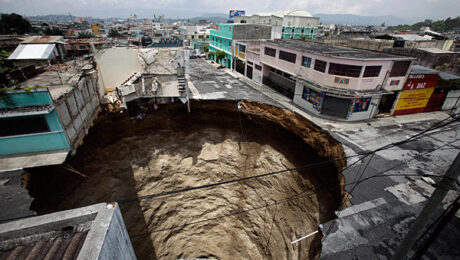
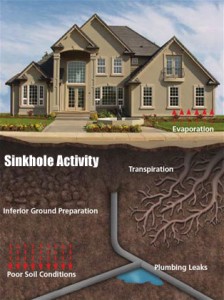 It’s the Great Florida Sinkhole Lottery and the payouts are big in Hernando County.
A Spring Hill couple notices cracks creeping across the floors of their home. They claim sinkhole damage and their insurance company cuts them a check for $206,000.
A widower returns from his wife’s funeral to find one room filled with water and a 2-inch gap between floor and door. He files a sinkhole claim and gets $211,000.
And a retiree from New York puts in a claim after his insurer says it plans to drop sinkhole coverage. He gets $260,000.
Insurance companies forked out more than a half-million dollars on these three houses alone, but the cracks and gaps are still there. None of the owners used the money to make repairs.
The house “can fall in the ground for all I care,” said retiree John Backer, who invested his $260,000 payout. “I made my money already.”
According to an investigation by the Tampa Bay Times, Backer is among hundreds of Floridians — especially those in the “sinkhole alley” of Hernando, Pasco, Hillsborough and Pinellas counties — who have paid off mortgages, put in pools, replaced roofs or otherwise used money from sinkhole claims to do something besides fix sinkhole damage.
The result: Homes from Brandon to Port Richey to Weeki Wachee sit unrepaired, decimating property values and draining millions of dollars in tax revenue from local governments already hard hit by the recession.
Since 2005, the Florida Legislature has repeatedly tried to find ways to ensure that legitimate sinkhole damage is covered and repaired while cutting down on the number of questionable claims. The latest attempt came in May with major changes to state law that require homeÂowners to repair damage and that make it less attractive to sue their insurance companies.
But despite all of the tinkering in Tallahassee, what lawmakers call “Hurricane Sinkhole” still roars unabated.
• The number of residential sinkhole claims filed with Citizens Property Insurance Corp., which insures more Florida homeowners than any other company, has nearly tripled in the past five years, from 1,482 claims in 2007 to 4,024 last year. The average claim now costs Citizens nearly $90,000. In 2010, the last year for which figures are available, the state-run company said it took in $32 million in premiums but incurred $245 million in sinkhole losses.
Soaring losses mean higher premiums for all of Citizens’ nearly 1.5 million policyholders, not just those in sinkhole-prone areas. Even homeowners who have policies with private insurers would be liable for a 6 percent surcharge.
• Citizens has contributed to its losses by opting in some cases to handle the sinkhole repairs itself.
Homeowners complain that contractors hired by Citizens do shoddy work, leading to lawsuits and settlements that can run into six figures. Citizens shelled out more than $350,000 in repairs, legal fees and settlement costs on a Hernando County house with a market value of just $39,500.
• Aggressive marketing by lawyers, contractors and public insurance adjusters drives up costs by encouraging homeowners with even minor cracks to file claims and, in many cases, sue.
The payoffs can be great — the public adjuster, who works for the homeowner, typically gets 10 percent of any insurance settlement while the lawyers walk away with up to 40 percent.
• Collusion among unscrupulous engineers and contractors costs insurers hundreds of thousands of dollars.
A contractor who worked closely with a well-known Brooksville sinkhole repair company faces felony charges of insurance fraud in what State Farm Insurance says was a conspiracy to inflate the cost of grout used to fill sinkholes under dozens of houses in the Tampa Bay area.
• Critics say Florida’s new sinkhole law is so flawed that there will be more, not fewer lawsuits against insurance companies.
And because the law exempts homeowners who sue and settle from the requirement to make repairs, houses with unrepaired sinkhole damage will continue to be a drag on property values and tax collections.
Stampede of claims
No one denies that Florida is prone to sinkholes.
Heavy rains, massive pumping of groundwater and other factors can speed sinkhole formation, but Florida’s Swiss-cheese geology and sandy soil have remained the same for eons. Thus no natural events explain the explosion in sinkhole claims in the past five years.
And nowhere has that explosion been greater than in Hernando County.
In a 2002 study by the insurance industry, Hernando wasn’t even listed among the seven Florida counties with the highest number of sinkhole claims. A decade later, Hernando leads the state.
“The incidence of claims is generally driven by the awareness of sinkholes or some type of scare tactics or advertising to homeÂowners saying, ‘You’ve got coverage now, you may not have coverage later so if you have a claim file it now,’ ” said George Sinn, a geotechnical engineer who works for both insurers and homeowners. “So you get people who are used to living with typical small hairline cracks filing claims.”
In 2005, Citizens received 113 sinkhole claims from Hernando. In the year just ended, there were 1,920 — more than twice as many as runner-up Pasco.
As the number of claims has soared, the value of Hernando homes and businesses has plunged. With nearly 3,000 owners since 2005 requesting an adjustment in values because of sinkhole activity, Hernando County Property Appraiser Alvin Mazourek pegs losses to the county’s market value at a staggering $283 million.
“Sinkholes do exist and the impact of such can be quite devastating, not to mention dangerous,” Mazourek wrote to a state lawmaker before the 2011 legislative session.
“But unfortunately . . . it seems that while the general public is now very quick to have the problem diagnosed, the desire to remedy the problem is not being met with the same urgency and more often than not, goes completely unrepaired.”
Mazourek wasn’t exaggerating.
Under state law, any insurance company that pays a sinkhole claim is supposed to file a notice with the clerk of court. The Tampa Bay Times looked at 593 notices Citizens filed in Hernando in 2008, 2009 and 2010, the years for which the notices clearly stated that a claim had been paid. (The forms changed in 2011.)
Of the 593 homes for which Citizens made payouts, county building records show no evidence that 282 were ever repaired — nearly half of the total.
Island of cement
The experiences of two Hernando County families insured by Citizens help explain why there are so many unrepaired houses and big insurance payouts.
Ronald Kotecki knew little about sinkholes when he and his wife moved from California to Spring Hill in 2004. Then water seeped into a back bedroom from a crack in the slab foundation.
Kotecki asked the foreman of a construction crew working nearby to take a look. Instead, the foreman sent over a public adjuster, a licensed insurance adjuster who works on behalf of the homeowner instead of the insurance company..
“He’s there five minutes and said, ‘You got a sinkhole,’ ” Kotecki recalled. “He said, ‘It’s not going to cost you anything.’ ”
When Citizens denied their claim, the Koteckis sued. They settled for around $217,000, the limit of their policy, with the lawyer taking a third, the adjuster 10 percent and the Koteckis the rest. They considered making repairs until the adjuster pointed out that there are companies that buy unrepaired sinkhole homes.
So instead of stabilizing the sinkhole and fixing the cracks, estimated to cost $300,000, they paid off their mortgage and other debts and sold the house for $190,000.
Six years and two owners later, that house remains unrepaired.
The Koteckis moved to another home in Spring Hill that also developed sinkhole-related problems. This time Citizens invoked its right under the Koteckis’ policy to make the repairs itself. It hired a contractor to stabilize the hole with grout at a cost of about $150,000, Kotecki said.
Citizens also wanted to be in charge of cosmetic repairs, which included painting, replacing a tile floor and installing pavers in the driveway and pool areas.
“That started taking forever,” said Kotecki, a retired magazine sales representative. “People weren’t showing up. When you’ve got a heart condition you don’t want all that stress.”
The Koteckis sued Citizens again, eventually settling for $117,000. After the lawyer and public adjuster took their cuts, the Koteckis were left with enough to make some but not all of the cosmetic repairs. New cracks already are appearing.
Still, “I feel a lot more comfortable when sitting on $150,000 of cement and grout,” Kotecki says. “You’re pretty much on an island of cement.”
Citizens’ odd logic
Judith and James Pierce are sitting on a lot of cement, too. But they’re not happy.
There are two main ways to fix sinkhole problems — stabilizing the hole with tons of grout, a cement-based material, or securing the house with steel pins or piers drilled deep into the ground. Engineers often recommend both methods to reduce the odds of the house developing future problems.
So the Pierces called a lawyer when Citizens, invoking its right to repair, chose to do grouting only, followed by cosmetic repairs.
“The lawyers said, ‘Let them do whatever they want and don’t say anything because they’ll screw up and then we can sue them,’ ” Judith Pierce, 53, recalled. “It’s a big game.”
Sure enough, there were problems. Newly installed pavers raised the floor level in the sun room so much the sliding doors to the pool didn’t work. A hot tub was left sitting outside so long that rats chewed through the wiring. Painting was sloppy.
The Pierces sued Citizens. They settled for $133,000, of which they got $71,000 after the lawyers and a public adjuster took their shares. A judge awarded the lawyers an additional $123,000.
Judith Pierce tallies what Citizens spent: At least $110,000 for grouting and inferior repairs followed by the settlement and extra attorney’s fees. A total of $366,000 for a house that the Pierces had on the market for three months and got one offer: $20,000.
Citizens won’t comment on matters involving individual policyholders. The company said it stopped its “election to repair” program in 2010 although it still considers handling repairs itself on a case-by-case basis.
Unintended effects
The Times analysis of Citizens’ paid claims in Hernando County found that 124 of the 593 policyholders who got payouts subsequently sued Citizens — one out of every five.
And of those who sued, 40 percent have never made repairs.
“Some of my colleagues have suggested that the largest expansion of gambling in the state of Florida has been with Citizens,” says Sen. Garrett Richter, a Naples Republican and chairman of the committee that pushed for Senate Bill 408 with its radical changes to sinkhole insurance in 2011.
The new law is supposed to reduce the number of claims and lawsuits in several ways:
• If an insurer denies a claim without testing for a sinkhole, the homeowner must pay up to $2,500 for testing if he wants to appeal. (The insurer refunds the money if a sinkhole loss is found.) Before, the homeowner could demand testing and not have to pay for it.
• Insurers don’t have to pay for below-ground stabilization until the homeowner contracts to have the work done according to recommendations in the insurer’s engineering report.
• Benefits are restricted to “structural damage” of the principal building (typically the house), and the definition of damage is now based on Florida construction and engineering codes.
“Structural damage really wasn’t defined very tightly in the statutes at all,” said James Knudson, a Senate attorney who helped draft the bill.
While some insurers said the damage had to be severe enough to affect a home’s structural integrity, attorneys for homeÂowners argued that it simply meant the structure was damaged. “You can see a huge difference between those two things,” Knudson said.
Critics say the new law hurts policyholders.
“Once that bill got in the hands of lobbyists, it created a lot of push to do anything that would discourage valid claims,” said Ted Corless, a Tampa lawyer who once represented State Farm and now represents homeÂowners. “It’s one giant mashed potato.”
Corless predicts the changes will lead to more litigation, not less. If so, the number of unrepaired houses could climb. HomeÂowners who settle a lawsuit with their insurers are exempt from a requirement that they use the money to stabilize the sinkhole.
“If you reach a settlement, then you’re outside of the sinkhole statute” and don’t have to make repairs, Knudson acknowledged.
The full impact of changes in the law won’t be known until all current policies are up for renewal. Insurers can now require an inspection at the homeowner’s expense before writing sinkhole coverage.
“We got one house approved (by Citizens) and it was an older home, but it was in pristine condition,” said Karen Lund, an agent with Whiting Insurance in Spring Hill. “We have two others in review, but in talking to other agents, they’ve gotten more declines than approvals.”
The likely result? HomeÂowners will complain and Florida lawmakers will continue to tinker. And that could scare even more homeowners into thinking they need to get in a claim before the law changes yet again.
A cheaper way
That’s what happened with Amy and Freddy Blackburn.
When it became a “tug of war” to open the French doors at their Spring Hill home, the couple suspected a sinkhole. Fearing the Legislature might let insurers drop sinkhole coverage, Amy Blackburn, the owner of record, filed a claim with Citizens. She sued after Citizens said it intended to have the hole filled with $150,000 worth of grout.
“We didn’t want grout,” Freddy Blackburn said. “You start putting grout in the ground, what’s that grout going to do to the environment?”
Citizens settled, and the Blackburns used the money to install steel piers for about $45,000. They wonder why Citizens didn’t consider that much cheaper fix.
“Even if you spent $4,000 or $6,000 on another opinion, you’re still $94,000 ahead,” Freddy Blackburn said. “That concerns me they didn’t try to find another option. That’s why they have to raise rates. Can you imagine getting $3,000 on a policy in premiums and then paying out $150,000 on sinkhole claims?”
Times researcher Carolyn Edds contributed to this report. Susan Taylor Martin can be reached at susan@tampabay.com. Dan DeWitt can be reached at dewitt@tampabay.com or (352) 754-6116.
A landslide of claims
Number of residential sinkhole claims filed with Citizens has been on the rise.
[footer1]| 2007 | 2011 | |
| Hernando | 421 | 1,920 |
| Hillsborough | 216 | 665 |
| Pasco | 653 | 888 |
| Pinellas | 85 | 237 |
| Statewide | 1,482 | 4,024 |
- Published in In the News